Calculating the exact number of roofing sheets required is a critical first step for any building project in Sri Lanka. An accurate estimate saves money, prevents material wastage, and keeps the construction process on schedule. This guide provides a straightforward, step-by-step process to how to calculate number of roofing sheets accurately, ensuring the roof structure is protected from Sri Lanka’s demanding weather.
Why Accurate Calculations for Roofing Material are Critical
Getting the calculation right has a significant impact on both the project budget and the building’s long-term durability. It is a crucial part of planning any construction.
Understanding the Impact on Your Building Budget
Roofing material typically accounts for 10-15% of the total construction cost of a house in Sri Lanka. A simple miscalculation can lead to material wastage that inflates project costs by 15-25%. On the other hand, a precise calculation for a modern material like Sivilima’s i-Roof can reduce wastage to as little as 5-7%, resulting in significant savings.
The Role of Climate When Calculating Roofing Needs
Sri Lanka’s climate makes accurate roofing calculations essential.
- Monsoon Rains: The island experiences intense rainfall, often between 1,500-2,500mm annually. A precise number of sheets ensures correct overlaps, which is critical for weatherproofing and preventing leaks.
- Temperature Variation: Frequent temperature shifts between 26°C and 32°C cause materials to expand and contract. A correctly measured and installed roof can manage this thermal expansion without compromising the structure.
- Installation Delays: Running short on material can halt construction, leaving the building’s structure exposed to potential rain damage.
The First Step: How to Accurately Measure Your Roof Area

An accurate calculation begins with precise measurements. This process involves more than just the building’s ground-level dimensions; it requires accounting for the roof’s actual surface area.
How to Measure Roof Length and Width
First, measure the length of the roof, which is the horizontal line along the peak (also called the ridge). Then, measure the width or span, which is the distance from the ridge down to the bottom edge of the roof (the eave). Always measure the actual roof surface, not the floor plan. It is important to include any overhangs in the measurement, as these sections also require cover.
How to Determine Your Roof Slope
The roof’s slope, or pitch, significantly increases its surface area. To get an accurate area calculation, you must multiply the flat area by a slope factor.
- 15° pitch: Slope Factor is 1.035
- 30° pitch: Slope Factor is 1.155
- 45° pitch: Slope Factor is 1.414
Understand the Effective Width vs. Full Width of a Roof Sheet

This is a critical detail where many calculation errors happen. Every roofing sheet has a full width and an effective width (or effective cover). The effective width is the actual area a sheet covers after overlapping with the adjacent sheet.
For example, Sivilima’s i-Roof Max sheets have a full width of 3 feet 5 inches, but the effective covering width is only 3 feet 1.5 inches. Always use the effective width for calculations to determine the correct number of sheets.
How to Calculate for Complex Roof Shapes
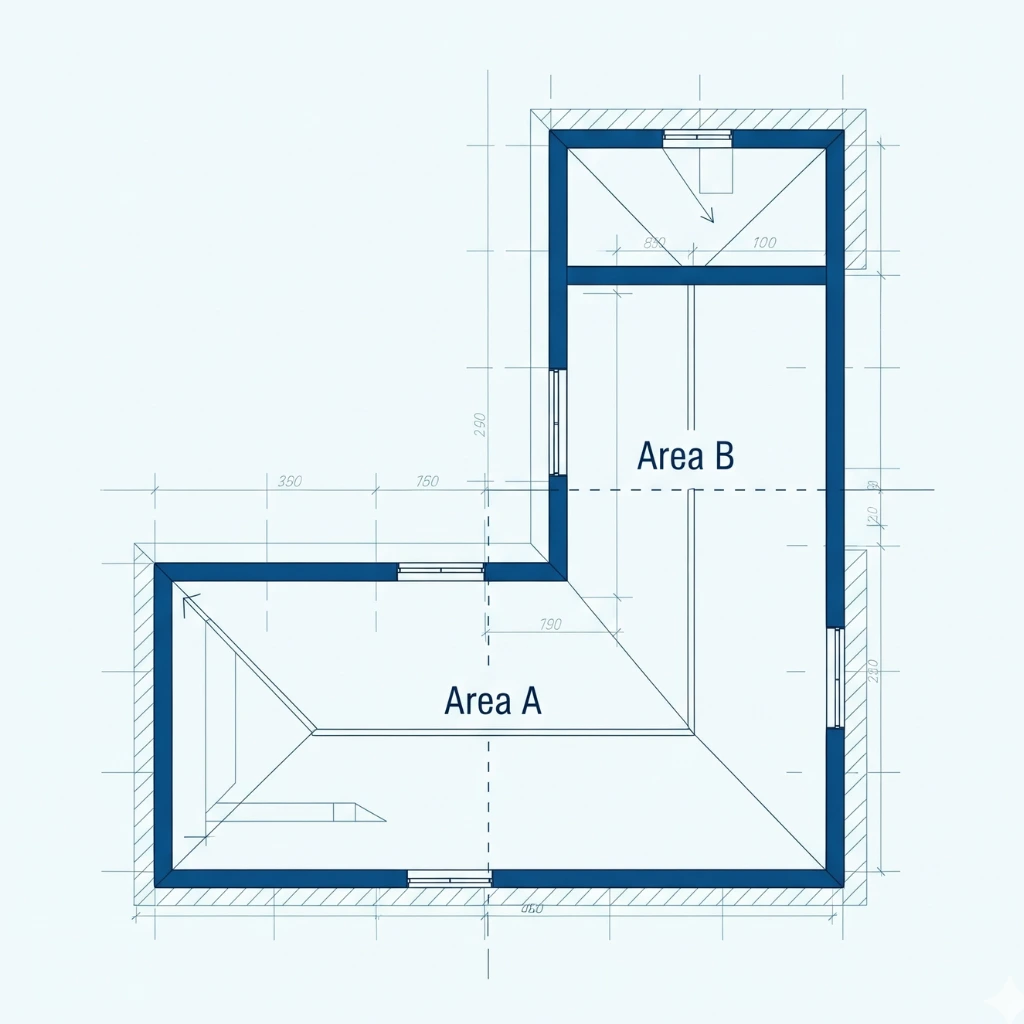
Many modern Sri Lankan houses have L-shaped or T-shaped roofs, not simple rectangles. The easiest way to calculate the area for these complex shapes is to break them down into simple sections.
- Divide the Roof: Look at your roof plan and divide the entire roof into a series of basic shapes, like rectangles and triangles.
- Calculate Each Area: Measure the dimensions for each individual rectangle and triangle separately.
- Add Them Together: Calculate the surface area for each shape (remembering to apply the slope factor) and then add all the areas together to get your total roof area.
The Core Calculation: How to Calculate the Number of Roof Sheets You Need
Follow these steps for a precise estimate of the roofing material you require.
Step 1: Calculate the Total Roof Area
The formula is simple:
Total Roof Area = (Roof Length × Roof Width) × Slope Factor
For a standard gable roof with two planes, calculate the area of one plane and multiply it by two. A proper calculation will help you select from the wide range of roofing sheets available.
Step 2: Determine the Effective Cover of a Single Roof Sheet
This is the usable coverage area of one sheet.
Effective Sheet Area = Sheet Length × Effective Sheet Width
For i-Roof Max, the effective width is a constant 3 feet 1.5 inches (0.95 meters). The length depends on the specific sheet size you choose for your roof.
Step 3: The Final Calculation for Your Sheet Count
Divide the total area of your roof by the effective coverage area of a single sheet.
Total Sheets Needed = Total Roof Area ÷ Effective Sheet Area
Always round the result up to the next whole number, as you cannot purchase a fraction of a roof sheet.
Worked Example: Calculating Roofing for a Typical Sri Lankan House
Let’s apply this to a real-world scenario for a common house size in Sri Lanka.
House Specifications and Material Selection
- Roof Dimensions: A single roof plane of 25 feet (Length) × 20 feet (Width/Span).
- Roof Slope: 30° (a common pitch for good drainage).
- Roofing Material: Sivilima offers a complete range of i-Roof roofing products designed for our climate.
Applying the Formula: A Practical Walkthrough
- Calculate Total Roof Area:(25 ft × 20 ft) × 1.155 (slope factor for 30°) = 577.5 sq ft.
- Calculate Sheets Needed for Width:The roof width is 20 ft. The effective width of an i-Roof Max sheet is 3.125 ft (3′ 1.5″).20 ft ÷ 3.125 ft = 6.4. You must round this up, so you will need 7 sheets across the width.
- Determine Sheet Length:The required length is 25 feet. Sivilima offers various lengths up to 24’5″, so the installation plan might involve using multiple sheets with a safe end overlap.
- Total Basic Requirement:You require 7 sheets to cover the roof area.
A Key Tip: Always Account for Extra Sheets (Wastage)
Every construction project involves cutting material to fit angles and edges. This is known as wastage. For a simple roof, a wastage allowance of 5-7% is standard.
- Final Calculation: 7 sheets × 1.07 (for 7% wastage) = 7.49.
You must round up and order 8 sheets. This ensures you have enough material to complete the job without delays. Remember to also account for the necessary i-Roof roofing accessories for a complete installation.
Frequently Asked Questions (FAQ)
How much extra roofing material should I order?
For a simple gable roof, ordering an extra 5-7% for wastage is safe. However, for more complex roof structures with multiple angled joints like hips (where two roof planes meet on an outside corner) and valleys (where they meet on an inside corner), you should increase this allowance to 10-15% to account for the larger number of angled cuts.
Does the slope of my roof change how many sheets I need?
Yes, absolutely. A steeper slope results in a larger surface area. A 30° pitched roof has 15.5% more surface area than a flat roof with the same ground dimensions. Ignoring the slope factor is a major error that will lead to a material shortage.
What is the most common mistake when you calculate roof sheet requirements?
The most frequent error is using the sheet’s full width instead of its effective covering width. For i-Roof, this 3.5-inch difference per sheet adds up quickly. On a 20-foot wide roof, this single mistake could leave you short by an entire sheet, causing a costly delay.
Get an Accurate Calculation for Your Roof Today
Your perfect roof starts with an accurate calculation. Following these steps ensures your building is protected and your budget stays on track.
Key Takeaways for Accurate Roofing Calculations
- Always measure the actual roof surface, not the ground dimensions.
- Use the correct slope factor to find the true total roof area.
- Critically, perform all calculations using the sheet’s effective width.
- For complex roofs, break them into simple shapes and add the areas together.
- Add a wastage allowance of 5-15%, depending on your roof’s complexity.
Your Next Step: Contact Sivilima for Expert Help
Don’t leave your roof calculation to chance. Our team is here to provide expert assistance, for free. For more details, you can also consult our Sivilima installation guides.
- Call our technical helpline: +94 72200 2200 for immediate assistance.
- Email your project details: info@sivilima.lk for a detailed quotation.
- Visit our main showroom: No 06, Lucas Road, Colombo 14, to speak with an expert.